AI Ad Spending Will Double and More by 2030. What It Means for Search and Chatbot Advertising

Most conversations about AI advertising start from the same assumption that the real prize sits inside the chatbot window. If ChatGPT, Gemini and Copilot are where consumers now search, compare and decide, the thinking goes, ad budgets will simply follow them into the chat. New forecast data suggests marketers planning their 2027 budgets around that assumption are planning around the wrong number.
EMARKETER's latest US AI Advertising Forecast, published in May 2026, puts total US AI ad spending at $32.03 billion this year, climbing to $68.25 billion by 2030, a 2.1x increase in four years. That is a fast-growing budget line by any measure. The more important number in the report, though, is not the total. It is where that money is actually going.
AI Ad Spending Forecast 2026-2030: Where the Growth Is Really Going
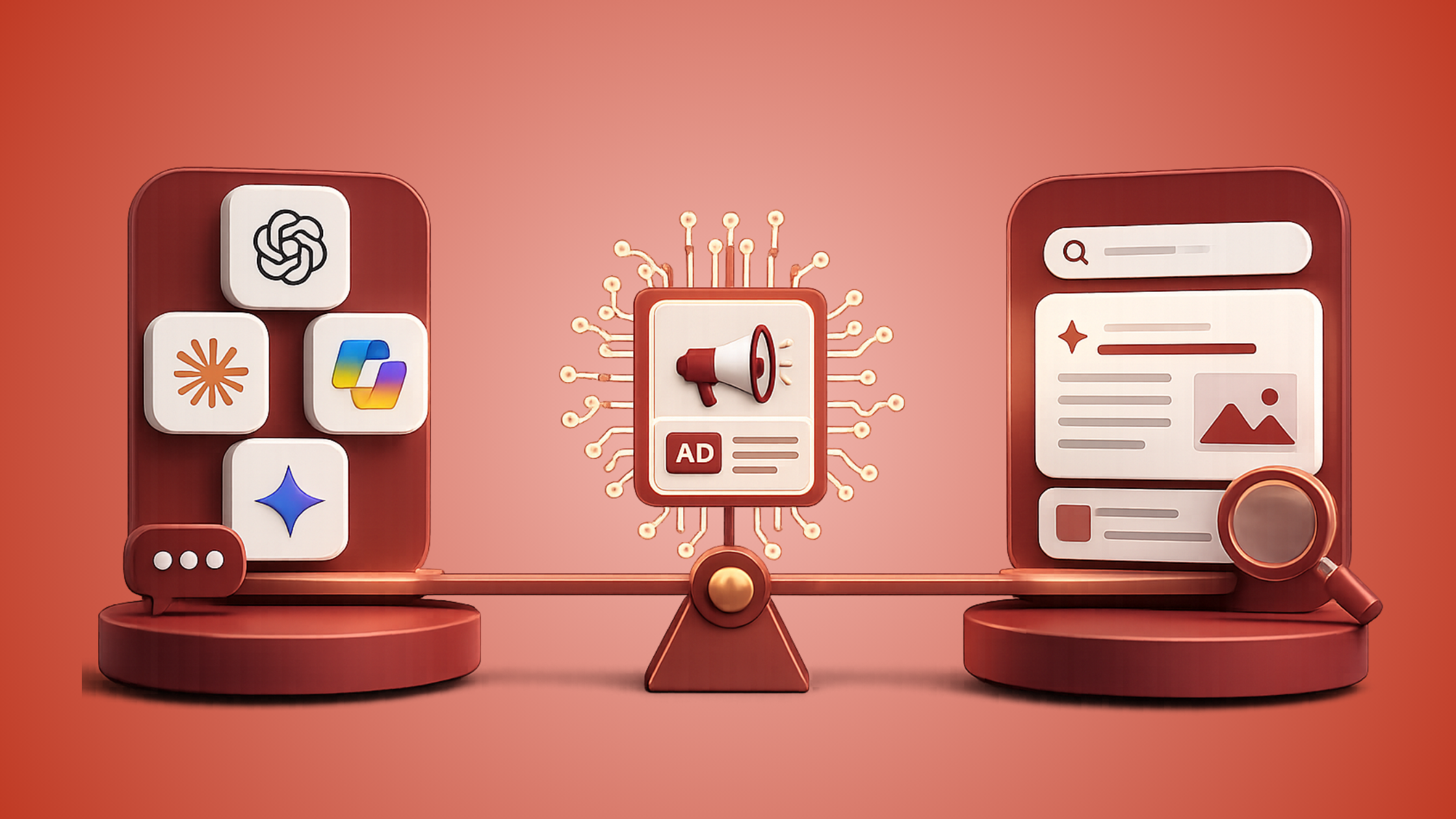
EMARKETER splits the AI ad market into three categories: advertising that runs alongside AI-generated content, such as Google's AI Overviews (AI search-adjacent), advertising placed inside AI-powered conversational search experiences, and advertising placed directly inside chatbot conversations.

Look at how that $68 billion splits and the picture gets clearer. More than 80% of AI advertising this year is expected to appear alongside AI-generated content, inside search summaries and AI Overviews, rather than inside a chatbot conversation. By 2030, spending tied to AI-powered search is still expected to sit well ahead of spending placed inside chatbots.
Chatbot Advertising Is Not Growing at the Pace the Hype Suggests
Chatbot advertising is forecast to generate less than $1 billion in US revenue this year, growing to just over $5 billion by 2030 (eMarketer 2026). That's genuine growth, more than five-fold in four years. Relative to a $68 billion market, chatbots remain a minority format, not the center of it.
For an industry that has spent the better part of two years treating ChatGPT ads as the headline story in AI advertising, that number is worth sitting with. We've tracked the early rollout of chatbot monetization as it happened, from OpenAI's first CPC tests through Microsoft's Copilot integrations. See Market Signals #1: AI, Ad Revenue, and the New Rules of Paid Media for that coverage. What the forecast adds is scale, and scale changes the conversation. A format can be strategically important for a handful of considered-purchase categories and still be too small to anchor a 2027 media plan. Both things are true here at once.
Why Search-Adjacent Formats Are Absorbing Most of the Budget
The reason is structural, not aesthetic. AI Overviews and AI-powered search summaries sit inside a query flow that advertisers, publishers and platforms have spent two decades building infrastructure around. Google, Microsoft and Amazon are extending an existing auction, an existing measurement stack and existing advertiser relationships into a new placement. Chatbot advertising is being built from a different starting point altogether: a new interface, a new trust model with users, and a new measurement approach, all at once.
Volume matters here too. Billions of search queries a day already run through AI-enhanced results. Chatbot conversation volume is growing quickly, but it is still a fraction of that. Ad revenue tends to follow query volume before it follows headlines.
The Same Pattern Shows Up on the Ecommerce Side as AI Becomes Part of the Shopping Journey
Pentaleap CEO Andreas Reiffen reached a related conclusion looking at a different part of the funnel: not ad spend, but actual transactions. Mapping end-to-end AI ecommerce transactions against total US ecommerce sales, he found that purchases completed entirely within an AI experience are projected to reach only about 1.54% of total US ecommerce sales by 2029. Widen the definition to any AI-influenced transaction, including AI Overviews and AI browser-driven visits, and the figure still tops out around 7.85% by the same year.
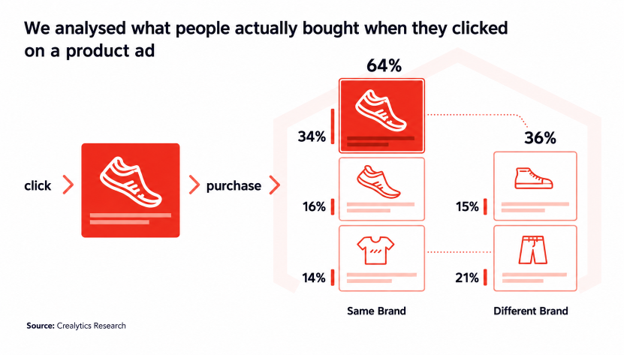
The analysis also draws on our own click-behavior data at Crealytics: when someone clicks a product ad, only about a third go on to buy the exact product they searched for. Most switch brand, product or category before converting. The volume moving toward AI surfaces is real and worth planning for, but it hasn't come close to replacing the retailer's role in the moments where a sale is actually decided.
AI Advertising Strategy: What Performance Marketing Leaders Should Do Next
Prioritize AI Search-Adjacent Advertising and GEO in Your 2027 Budget
If more than 80% of AI ad spend sits alongside AI-generated search content this year, and that category stays the larger one through 2030, budget conversations should reflect that weighting now. This is a content and visibility problem before it's a media-buying problem: getting cited, summarized and linked inside an AI Overview depends on structured markup, clear sourcing and content that answers a query directly, not just a well-funded campaign sitting next to it. Teams that treat this as an extension of GEO work will be better positioned than teams waiting for a formal ad product to show up.
· Audit structured data and schema markup so AI Overviews and AI search results can cite your product and content pages.
· Rework top-funnel content to answer queries directly, rather than optimizing for keywords alone.
· Shift a defined share of 2027 test budget away from chatbot-only pilots and into AI-search visibility work this quarter.
Test Chatbot Advertising, But Size the Budget to Match the Market
A five-fold increase by 2030 is a real opportunity, particularly for considered-purchase categories where AI chat is already part of the research journey. A $5 billion market by 2030 is not, however, a channel to build next year's media strategy around. Early tests should be structured to build learning on format and measurement, not to hit performance targets the current inventory can't yet support.
· Cap chatbot ad tests at a small, defined share of budget, treated as a pilot rather than a scaled channel.
· Focus early tests on considered-purchase categories where AI chat already plays a role in research.
· Set learning goals for these tests, such as creative format and attribution, instead of hard performance KPIs.
Build Cross-Format Measurement for AI-Influenced Advertising
Neither format maps cleanly to last-click attribution. AI Overviews-style placements and chatbot placements both shape a decision before a user reaches a page that records a conversion. Incrementality testing and blended measurement matter more here, not less, as budget moves toward AI-influenced placements of any kind.
· Move AI-influenced placements out of last-click reporting and into incrementality or blended measurement models.
· Run holdout or geo-based incrementality tests specifically for AI search-adjacent and chatbot placements.
· Set expectations with stakeholders that AI-influenced impact will show up earlier in the funnel than in last-click conversion data.
The Opportunity Is Bigger Than the Headlines. It's Just Not Where Most Marketing Leaders Are Looking
The headline number, AI ad spend more than doubling by 2030, is accurate and worth planning around. The part of the forecast that should actually change behavior is the mix underneath it. Most of that growth sits in search-adjacent formats that already resemble the media buying most performance teams understand well, rather than in a new chatbot-native advertising model still working out how to scale.
The advertisers who win this shift won't be the ones who moved fastest into chatbots. They'll be the ones who read the mix correctly and put their budget where the volume already is.
Key Takeaways
· AI ad spend is doubling, not just growing. EMARKETER forecasts US AI advertising revenue rising from $32.03 billion in 2026 to $68.25 billion by 2030, a 2.1x increase.
· Most of that money isn't going into chatbots. More than 80% of AI advertising this year appears alongside AI-generated content, such as Google's AI Overviews, rather than inside chatbot conversations.
· Chatbot advertising is real, but still small. US chatbot ad revenue is forecast to grow from under $1 billion this year to just over $5 billion by 2030, inside a $68 billion overall market.
· Budget weighting should follow the mix, not the headlines. Search-adjacent formats deserve near-term priority. Chatbot tests should be sized to the actual market, not to the volume of industry conversation about it.
---
Want to prepare your brand for AI-powered search and advertising? Reach out to us.
Relevant Insights
· Article: Market Signals #1: AI, Ad Revenue, and the New Rules of Paid Media
· Article: ChatGPT Ads: A Strategic Preparation Guide for Digital Media Leaders
· Article: How to Optimise for Generative AI Search: GEO vs. SEO
About Crealytics
Crealytics is an award-winning full-funnel digital marketing agency fueling the profitable growth of over 100 well-known B2C and B2B businesses, including ASOS, The Hut Group, Staples and Urban Outfitters. A global company with an inclusive team of 100+ international employees, we operate from our hubs in Berlin, New York, Chicago, London, and Mumbai.
EXPERT INSIGHTS