The Zero-Click Customer Journey: What It Means for Performance

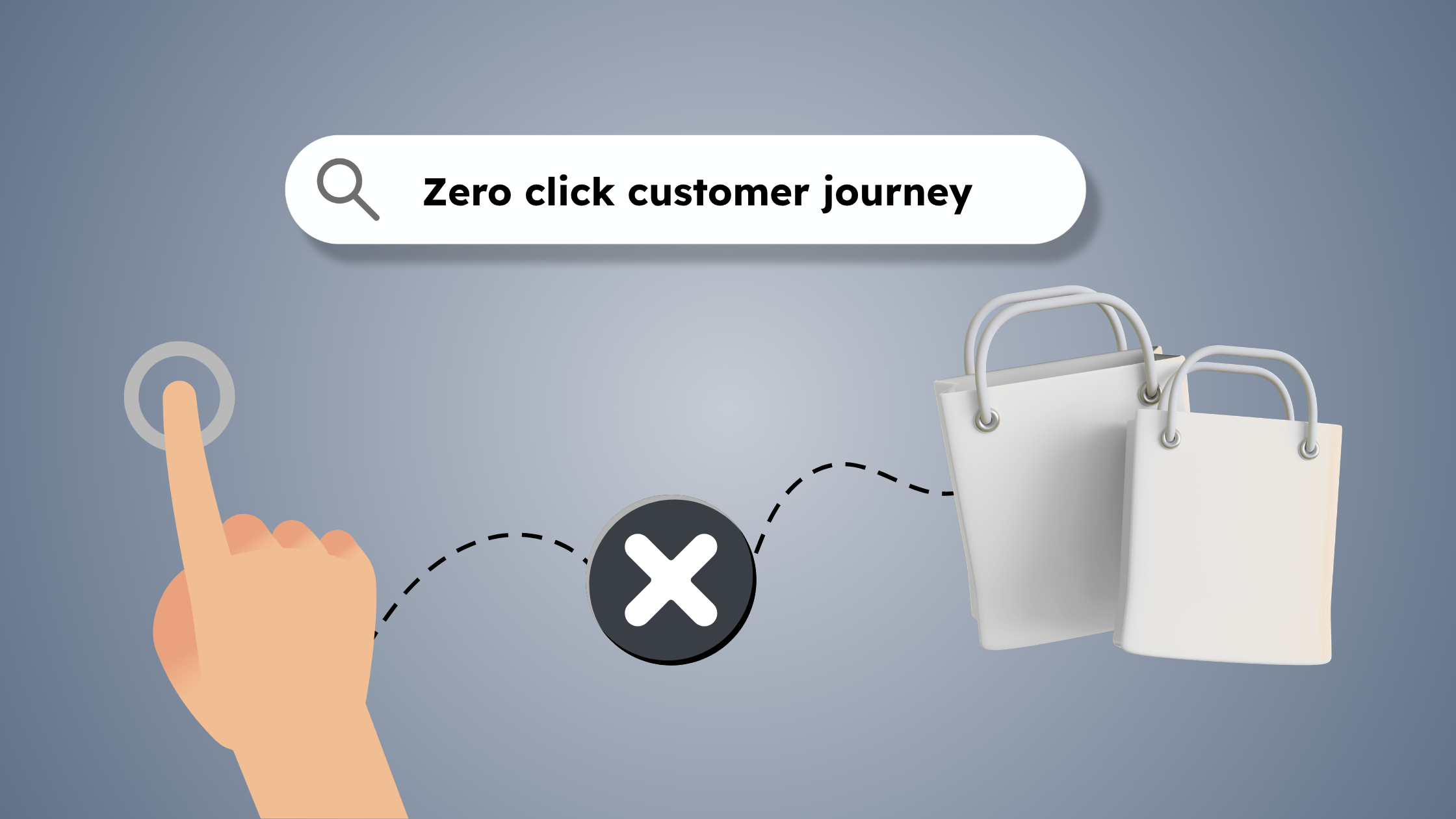
The structure of digital discovery is changing. Increasingly, consumers reach decisions without visiting a brand’s website. Search engines, retail platforms, and AI interfaces now surface answers, recommendations, and purchase options directly within their environments. This shift is often described as the zero-click customer journey.
Data already reflects this change. Research from SparkToro shows that close to 60% of Google searches end without a click to an external website. At the same time, studies referenced by Bain & Company indicate that AI-powered search experiences are accelerating this behavior by resolving user intent earlier in the journey.
For senior leadership teams, the implication is practical: performance marketing can no longer rely solely on driving traffic. It must increasingly influence decisions that happen before a click ever occurs.
What Is the Zero-Click Customer Journey in Digital Marketing?
The zero-click journey describes a path where discovery, evaluation, and sometimes even conversion occur within a single platform or interface.
This happens across three major environments:
· AI assistants and aggregators: Tools like ChatGPT or Perplexity synthesize information from multiple sources and present a single answer, reducing the need for further exploration.
· Search engines: Featured snippets, shopping units, and AI-generated answers provide direct responses without requiring site visits.
· Retail media platforms: Product discovery, comparison, and purchase happen within marketplaces such as Amazon or Walmart.
The shift is structural. Platforms now act as decision environments, not just navigation layers. As a result, the traditional model of “impression → click → website → conversion” is becoming less central.
Why Zero-Click Behavior Is Increasing Across Search, AI, and Retail Media
How Platforms Are Optimizing for Retention and In-Platform Engagement
Search engines and retail platforms benefit when users stay within their ecosystem. Features such as instant answers, embedded product listings, and native checkout reduce friction and increase session value.
From a performance perspective, this means platforms increasingly capture both attention and transaction, rather than handing traffic off to external sites.
How Generative AI Is Reshaping Discovery and Reducing Clicks
Generative AI changes how users interact with information. Instead of reviewing multiple links, users receive synthesized answers.
According to insights highlighted by WARC, AI-led discovery compresses the consideration phase by presenting pre-processed recommendations. This reduces the number of touchpoints required before a decision.
For performance teams, fewer touchpoints mean fewer measurable interactions, even if influence remains high.
Relevant article: How to Optimise for Generative AI Search: GEO vs. SEO
How Retail Media Platforms Combine Discovery, Evaluation, and Conversion
Retail media networks combine intent, product data, and transaction capability in one place. A user can search, compare, and purchase without leaving the platform.
This creates a closed-loop environment where:
· Attribution is platform-controlled
· Incrementality becomes harder to isolate
· Brand visibility within the platform becomes critical
How the Zero-Click Journey Is Changing Performance Marketing Strategy
Why Traffic Is No Longer the Primary KPI for Performance Marketing
Historically, traffic growth served as a proxy for demand generation. In a zero-click environment, demand can be created and fulfilled without site visits.
What this means in practice:
· Lower traffic does not necessarily indicate weaker performance
· Platform-level engagement and conversion signals gain importance
· Measurement frameworks must account for in-platform influence
For example, a product featured in a shopping unit may drive a purchase without generating a click. Traditional analytics would not capture this interaction.
Why Visibility Now Depends on Platform Inclusion, Not Just Rankings
In a zero-click journey, visibility depends less on ranking position and more on whether a brand is included in platform-generated outputs.
This applies across environments:
· Appearing in AI-generated answers
· Being selected within product recommendation modules
· Being surfaced in retail media placements
This shift places greater emphasis on:
· Structured product data
· Strong brand signals
· Consistent performance history
Platforms increasingly rely on these signals to determine which brands to surface.
Why Attribution Is Becoming Less Deterministic in AI-Led Journeys
As interactions move inside platforms, external tracking weakens. Third-party cookies already limited cross-site visibility. Zero-click environments extend this limitation further.
Insights from Bain & Company highlight that AI-driven journeys often obscure individual touchpoints, making last-click attribution less representative of actual influence.
What this means:
· Platform-reported performance becomes more prominent
· Incrementality testing becomes more critical
· Marketing mix modeling gains relevance for strategic decisions
Why Creative and Brand Signals Drive More Performance Impact
When users do not click, decisions rely more heavily on what they see within the platform itself.
This elevates:
· Product imagery and titles in retail media
· Ad formats that communicate value instantly
· Brand familiarity and trust signals
According to Kantar normative data, creative quality is the single biggest driver of growth in brand impact, driving 49% of brand impact across ad campaigns. In zero-click environments, this influence becomes more immediate because there is no intermediate landing page to compensate.
Strategic Actions for Leadership Teams in a Zero-Click Environment
Redefine Performance Metrics Beyond Click-Based KPIs
Expand performance frameworks to reflect how decisions now occur within platforms.
Prioritize:
· In-platform conversion metrics
· Share of voice within platform environments
· Contribution to incremental revenue
Align measurement with financial outcomes such as contribution margin and payback period to ensure marketing performance translates into business impact.
Prioritize Platform-Native Optimization Across Channels
Adapt execution to how platforms surface and rank content.
Focus on:
· Optimizing product feeds for retail media environments
· Structuring content for AI readability and extraction
· Aligning creative formats with platform-specific placements
Ensure platforms can interpret, rank, and present brand assets effectively within their own ecosystems.
Relevant insight: The State Of Retail Media: Learnings from 100 Retail Brand Executives
Build Measurement Frameworks That Capture Incremental Impact
Shift from deterministic tracking to methods that measure impact without relying on user-level visibility.
Implement:
· Geo-based incrementality tests
· Controlled holdout experiments
· Marketing mix modeling for cross-channel impact
Use these approaches to quantify performance where direct attribution is no longer fully observable.
Strengthen Brand Signals to Improve Paid Media Efficiency
Treat brand strength as a measurable driver of performance efficiency.
Invest in:
· Increasing branded search demand
· Improving engagement quality across channels
· Strengthening first-party data signals
Reinforce the feedback loop where stronger brand signals improve platform visibility, which in turn drives higher conversion efficiency.
Read our article What Brand Signals Now Drive Paid Media Efficiency to understand which brand signals are shaping paid media efficiency
Conclusion: Adapting Performance Marketing to the Zero-Click Future
The zero-click customer journey reflects a broader shift in how digital ecosystems operate. Platforms now manage discovery, evaluation, and conversion within their own environments, supported by AI and integrated commerce capabilities.
For performance marketing, this changes both execution and measurement. Traffic becomes one of many signals rather than the central objective. Visibility depends on inclusion within platform outputs. Attribution requires new approaches that capture influence beyond clicks.
Leadership teams that recognize these changes early can build more resilient strategies. By focusing on platform-native optimization, robust measurement, and strong brand signals, they can continue to drive growth even as the structure of the customer journey evolves.
---
Unsure how zero-click behavior is impacting your paid media performance? Reach out to us.
Relevant Insights:
· Article: Will LLMs Replace Search Engines? How Brands Can Stay Visible in the AI Age
· Presentation: Triangulation: How to Master Your Marketing Measurement and Maximize ROI
About Crealytics
Crealytics is an award-winning full-funnel digital marketing agency fueling the profitable growth of over 100 well-known B2C and B2B businesses, including ASOS, The Hut Group, Staples and Urban Outfitters. A global company with an inclusive team of 100+ international employees, we operate from our hubs in Berlin, New York, Chicago, London, and Mumbai.
EXPERT INSIGHTS