What Pride Month Revealed About the Relationship Between Brand Trust and Advertising Performance

Pride Month has always been a visible moment in the marketing calendar. In 2026, it has also become one of the clearest demonstrations of how brand trust influences advertising performance.
As brands made different decisions about whether to engage, pull back, or remain consistent, Pride Month created something marketers rarely get to observe in real time: how consumers respond when advertising either reinforces an established brand position or attempts to create one overnight.
The commercial lesson extends well beyond June.
Marketing effectiveness research has consistently shown that advertising performs better when consumers already trust the brand behind the message. Pride Month simply provides a highly visible example of that principle in action.
This article explores what the latest audience, media and marketing effectiveness data reveals, and why marketing leaders should increasingly view brand trust as one of advertising’s most valuable performance assets.
“71% of Americans agree that brands and companies should be able to show support to the LGBTQ+ community during Pride Month if they want to.” (GLAAD / Ipsos consumer survey)
Why the LGBTQ+ Media Opportunity Is Larger Than Most Media Plans Reflect
The starting point for any media conversation is audience size, and on that measure, the LGBTQ+ community is no longer a niche segment by any reasonable definition. Gallup polling, cited widely across eMarketer's advertising coverage, puts the LGBTQ+ share of US adults at roughly 1 in 11, rising to nearly one in four among Gen Z. Statista's advertising research places annual LGBTQ+ buying power in the trillion-dollar range, a figure now large enough to function as its own addressable market rather than a sub-segment of general audience planning.
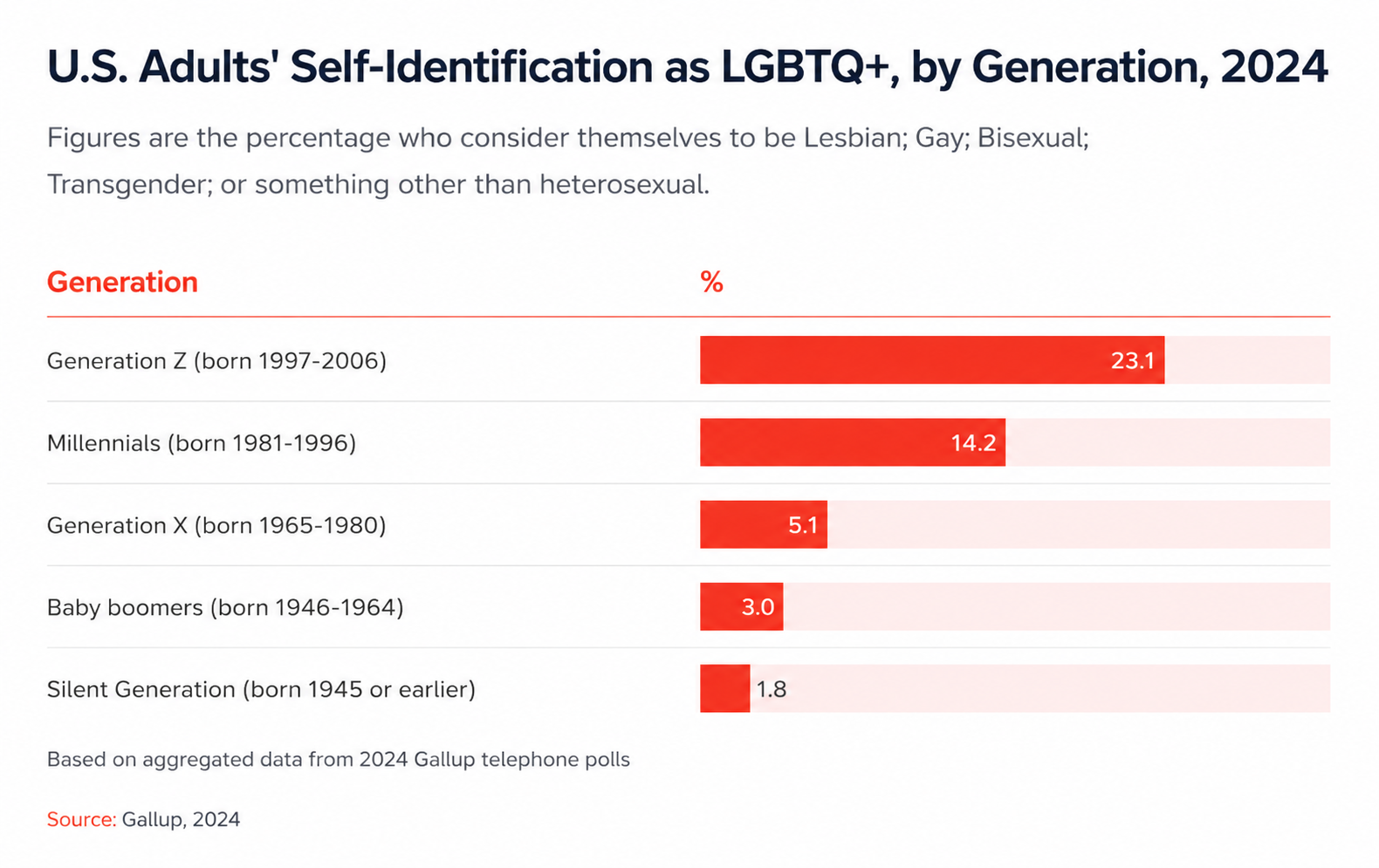
23.1% of Gen Z US adults identify as LGBTQ+, according to Gallup polling, a demographic increasingly central to long-term audience growth strategy.
Despite that scale, LGBTQ+-focused media remains a small fraction of overall ad investment. The ANA's LGBTQ+ Marketing Inclusion Report finds that only 34% of marketers currently include LGBTQ+-targeted media in their plans at all, a gap between audience size and media investment that is unusually wide compared to other major demographic segments.
For media planners, that gap is the headline. An audience of this scale, with spending power in the trillions and a media plan inclusion rate well under half, is exactly the kind of mismatch that tends to correct as data becomes harder to ignore. eMarketer's market coverage points specifically to LGBTQ+ streaming and digital platforms, such as Revry, as a growing supply-side response to this gap, giving advertisers more inventory built specifically to reach this audience with context and relevance, rather than only general-market placements.
Brand Trust Changes How Advertising Performs
Move from media reach to brand perception, and the data becomes more specific about what actually builds trust. GLAAD's nationally representative Ipsos survey found that 70% of Americans say a brand offering LGBTQ+ Pride merchandise has either a positive or neutral effect on their purchasing decisions, meaning the downside risk many brands assume going into Pride Month is, for the large majority of the general population, smaller than commonly perceived.
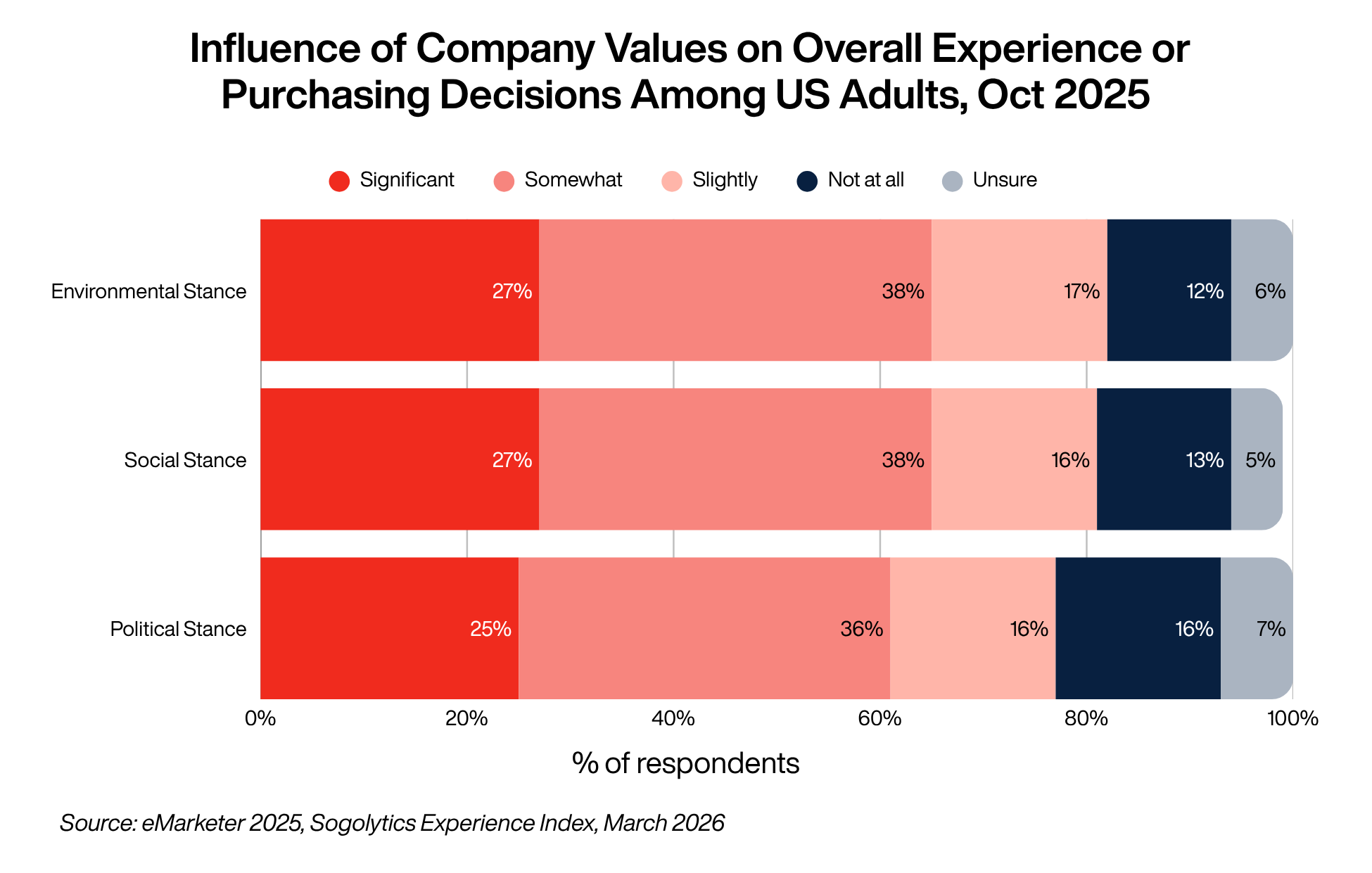
The eMarketer survey found 81% of Americans believe that a brands’ social stance at least slightly affects their purchasing decision.
Among the audience that matters most for long-term brand equity, the picture is even clearer. eMarketer's analysis found that consumers favoring continued brand engagement on social issues outnumber those who prefer brands pull back by a margin of four or five to one. 45% of LGBTQ+ adults want to see brands deploy a year-round content strategy beyond June. Thirty-nine percent of the general public agreed.
These are meaningful ratios for a topic often treated internally as politically balanced or high-risk in either direction.
eMarketer's brand-level reporting backs this up with real performance data. Costco, which has maintained its broader diversity commitments without a major public reversal, continues to post steady sales gains. Levi Strauss, leaning fully into Pride this year with a public statement built on what the company called 'decades of solidarity' alongside donations and parade sponsorships, is positioned by eMarketer as benefiting from a long-standing, credible position rather than a one-off campaign. Apple's expanded 2026 Pride Collection, including a Pride Edition Sport Loop and a new 'Pride Luminance' watch face, has drawn similar coverage, with eMarketer describing the launch as 'intentional rather than reactive,' a brand using scale and timing to signal confidence rather than caution.
“Apple’s approach feels intentional rather than reactive.” (eMarketer, on Apple’s 2026 Pride Collection)
The pattern across these examples is consistent: brands with a sustained, multi-year position on LGBTQ+ engagement are the ones eMarketer highlights as performing well, regardless of the broader market's caution.
These examples matter because they demonstrate a broader commercial principle. None of these campaigns needed to establish credibility. They reinforced credibility that already existed.
That changes how advertising performs.
Consumers spend less time questioning authenticity and more time engaging with the message itself. Media investment becomes more efficient because campaigns build upon existing trust instead of trying to earn it from scratch.
Consistency Lowers the Cost of Persuasion
WARC’s Cannes Lions coverage captured this idea through Kraft Heinz US CMO Todd Kaplan’s description of brand building as “pointillism”, thousands of consistent signals accumulated over time rather than isolated campaign moments. That principle applies directly to media performance.
Every consistent campaign reduces the amount of persuasion required from the next one. Over time, trust becomes a commercial asset that improves the return on future media investment. This is particularly relevant as media costs continue to rise.
When acquisition becomes more expensive, improving advertising efficiency becomes just as important as improving targeting.
Brands with established credibility often require fewer signals to convince consumers because belief already exists before the impression is served.
Viewed through that lens, brand investment and performance marketing are not competing priorities. One improves the effectiveness of the other.
What Pride Month Behaviors Means for Marketing Leaders
Put the media and brand data together, and the implication for marketing leadership is less about whether to engage with Pride Month specifically, and more about how to evaluate an underserved audience opportunity that happens to be unusually well documented this year.
Treat the media gap as an investment case, not a sensitivity
A 34% media-plan inclusion rate against a 23%-and-growing Gen Z audience share is the kind of gap that shows up clearly in any standard market-sizing exercise. Framing LGBTQ+-focused media as an underweighted opportunity, supported by Statista's spending-power data and the growing supply of dedicated platforms eMarketer has tracked, gives marketing leaders a stronger basis for budget conversations than a values-based argument alone.
Evaluate engagement as a multi-year pattern, not a single campaign decision
A campaign is judged by what it appears to confirm about a brand's broader position, not by its content alone. The brands that come across as credible this year are, with notable consistency, the ones with an established multi-year track record. That suggests the practical question for marketing leaders is not 'what should this year's campaign say,' but 'does this year's decision extend a pattern we can credibly sustain.'
The Opportunity Is in the Gap Between LGBTQ+ Audience Size and Media Investment
The most useful way to read this year's Pride Month data is not as a story about political pressure, but as a story about a gap between audience scale and media investment that the numbers describe with unusual clarity. A large, high-spending, fast-growing audience; a media-plan inclusion rate well under half; consumer sentiment running four to five to one in favor of continued engagement; and a small set of brands using consistency to differentiate themselves from a more cautious field.
For marketing leaders, that combination of facts reads less like a sensitive seasonal decision and more like an underweighted line in the media plan. The brands eMarketer and WARC point to as performing well this year are not the ones doing the most. They are the ones doing the same thing they have done for several years running. That is a more useful operating principle for marketing leadership than any single campaign decision: trust compounds with consistency, and the data this Pride Month makes that unusually visible.
Key Takeaways
· The audience is bigger than the investment. LGBTQ+ adults represent about 1 in 11 Americans (nearly 1 in 4 of Gen Z) with trillion-dollar buying power, yet only 34% of marketers include LGBTQ+-targeted media in their plans, a gap, not a niche.
· Trust is a performance multiplier, not just a values statement. Brands with long-standing, credible positions (Costco, Levi's, Apple) see stronger results because audiences spend less energy questioning authenticity and more time engaging with the message.
· Consistency lowers the cost of persuasion. Sustained multi-year engagement compounds into cheaper, more efficient advertising over time. Brand building and performance marketing reinforce each other rather than compete for budget.
· The real question isn't "should we participate this year?" It's "does this decision extend a pattern we can credibly sustain?" Treating the media gap as an underweighted investment opportunity, not a one-off seasonal risk, is the more useful frame.
---
Unsure whether your brand investments are improving paid media efficiency? Reach out to us.
Relevant Insights
· Article: 5 Consumer Behavior Shifts Shaping the Future of Paid Media
· Article: How Does Incrementality Shape Budget Allocation Across Channels?
· Article: What Brand Signals Now Drive Paid Media Efficiency
About Crealytics
Crealytics is an award-winning full-funnel digital marketing agency fueling the profitable growth of over 100 well-known B2C and B2B businesses, including ASOS, The Hut Group, Staples and Urban Outfitters. A global company with an inclusive team of 100+ international employees, we operate from our hubs in Berlin, New York, Chicago, London, and Mumbai.
EXPERT INSIGHTS