What AI Search Reveals About Consumer Behavior

For most of the past decade, consumer search behavior was relatively stable. Someone needed something, typed a query into Google, scanned a results page, and clicked through to a website. That sequence was predictable enough that an entire industry of measurement, optimization, and attribution was built around it.
That sequence is changing. AI-powered search tools including ChatGPT, Google AI Mode, Google AI Overviews, Perplexity, and Gemini are now part of how a meaningful share of consumers find information, compare products, and form brand preferences. The behavior patterns emerging from these tools are distinct from traditional search in ways that are worth understanding carefully, both for what they reveal about how consumers now make decisions, and for what that means for how brands should approach visibility, content, and measurement.
This piece looks at what the current data shows about AI search adoption, how consumer intent behaves differently in conversational search environments, and what the practical implications are for marketing and media teams.
How Quickly AI Search Has Entered the Consumer Journey
The adoption curve has moved faster than most forecasts anticipated. 42.7% of global consumers used an AI tool for local search in the past month, according to a 2026 Consumer Search Behaviors Report, which surveyed 3,848 consumers globally. That figure is not concentrated in early adopters. The shift is visible at the platform level too. 37% of consumers now start their search journey with an AI tool rather than a traditional search engine, according to the 2026 AI and Search Behavior Study. That does not mean traditional search has been displaced. It means that for a growing segment of consumers, AI has become the first stop rather than an alternative.
The instinct is to read a number like that as Google losing ground. The data says the opposite.
One of the more counterintuitive findings in the recent data comes from eMarketer's May 2026 consumer survey. 82% of weekly AI users use Google Search every day, compared with 71% of all internet users. AI search and traditional search appear to be complementary behaviors for most consumers rather than substitutes. The heaviest users of AI tools are also, on average, heavier users of Google.
The practical implication is that AI search adoption does not reduce the importance of traditional search presence. It adds a new surface where consumer behavior is developing alongside existing habits, not instead of them.
How Consumer Intent Behaves Differently in AI Search Environments
The more commercially significant shift is not how many people use AI search. It is how their intent develops when they do.
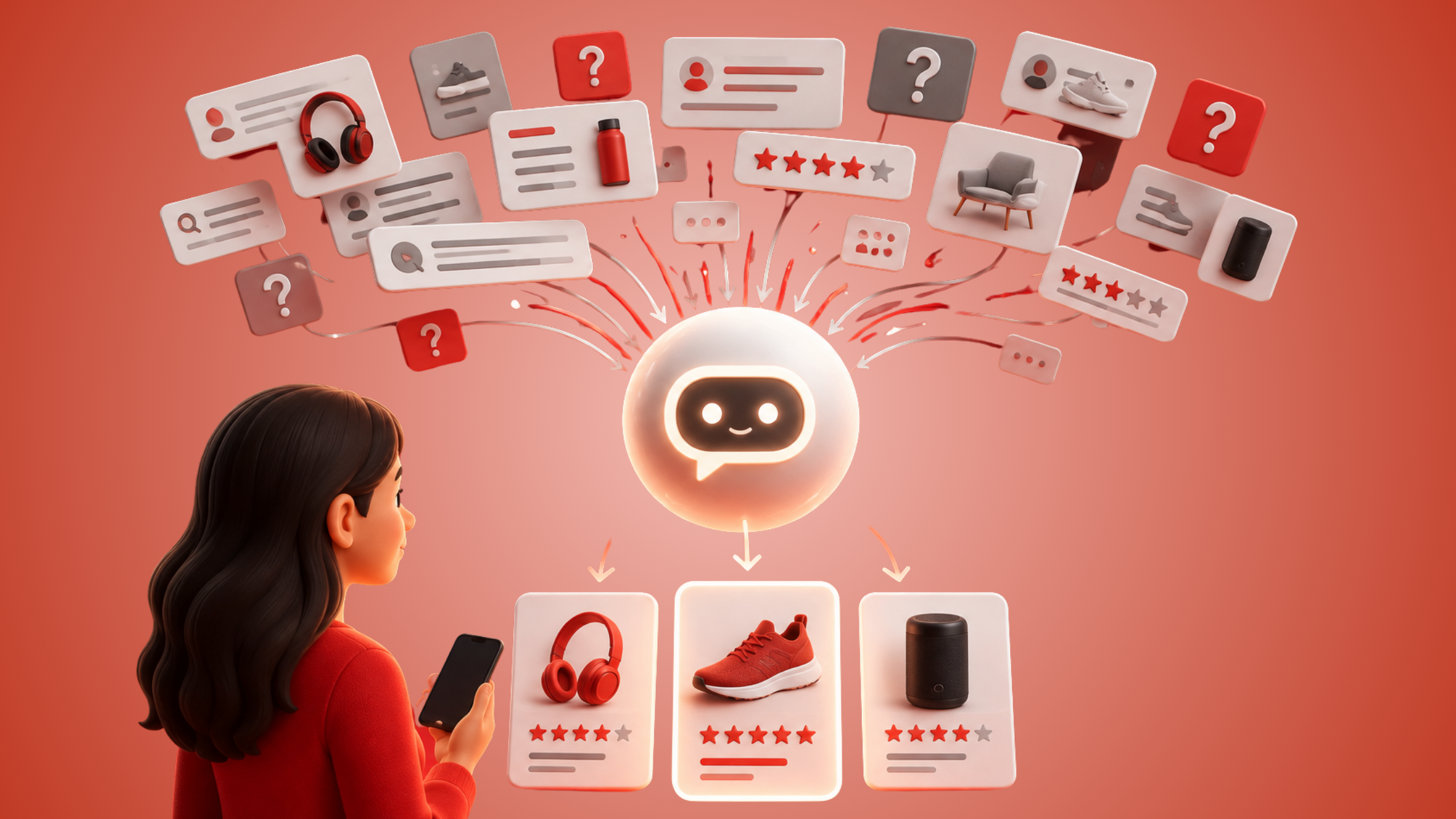
Traditional search captures intent that already exists. A consumer types a query because they know what they are looking for. AI search can build intent inside the conversation. Someone who opens ChatGPT with a broad question about home improvement can leave that exchange with a specific brand preference they did not hold at the start, formed entirely inside the answer and before any site visit.
That shows up in the downstream data. Visitors from AI search tools spend 68% more time on-site than those from traditional organic search. Previsible's July 2026 AI Traffic Report found that users arriving from AI tools land on product pages with purchase intent already formed. In ecommerce, AI-referred traffic grew 37 times from near zero in the 12 months to July 2026.
Our read is that the funnel is not collapsing. It is relocating. The comparison of options and evaluation of alternatives that used to happen across a series of browser tabs now happens inside a single conversation. A consumer arriving from an AI tool may be functionally at the bottom of the funnel on their first visit. Treating that visitor to a full awareness-to-conversion nurture sequence wastes the head start they arrive with, and it is the kind of mismatch that quietly drags down conversion rates on otherwise strong traffic.
What Consumers Are Using AI Search to Find, and Where Brands Appear
Consumer search habits describe buying behaviors and product discovery shifting toward chatbot environments. Consumers are increasingly turning to AI tools for purchase recommendations without using traditional search at any point in that journey. That pattern is most visible in ecommerce, where AI-referred traffic grew 37 times from near zero in the 12 months to July 2026.
The distribution of AI citations matters as much as the volume. 44.2% of all large language model citations come from the first 30% of a piece of content, specifically the introduction. Content structured to answer a question directly in its opening section is more likely to be cited in AI responses than content that builds toward a conclusion.
Brand visibility in AI responses does not map cleanly onto traditional search rankings. A page can rank first on Google and still be absent from AI-generated answers, because the signals that drive AI citations can differ from the signals that drive Google rankings. This creates a situation where brands with strong traditional SEO may still be underrepresented in the AI responses their target consumers are reading.
The trust dimension adds another layer. An AI-generated shortlist of recommended brands tends to contain only a small number of options. Brands that appear on that shortlist gain a trust signal. Brands that do not are often excluded from the consideration set before a consumer visits any website.
Why Measurement Has Not Caught Up With Consumer Behavior
One of the practical challenges AI search creates for marketing teams is that standard analytics tools were built for a world where most discovery happened through trackable clicks. AI search introduces a category of influence that does not always generate a referral cookie.
For example, when a consumer uses ChatGPT to research a product category, forms a brand preference during that conversation, and later visits the brand's website directly, that visit registers as direct traffic in GA4. The AI referral is invisible. 54% of US marketers plan to implement generative engine optimization within three to six months, but only 23% currently invest in measuring it, according to eMarketer's January 2026 data. The gap between adoption intent and current measurement practice is significant.
Two proxies are workable today. Branded search lift is the strongest: if an AI tool mentions a brand often in relevant responses, a share of those users will later search that brand on Google, and that lift is a measurable signal standard referral tracking misses. Self-reported attribution is the useful complement: adding AI-tool options to demo request forms, post-purchase surveys, and sales discovery calls surfaces referral that analytics will never record.
The blend applies here as much as anywhere. No single metric will capture AI search's contribution, so the answer is to triangulate branded search trends, self-reported attribution, and segmented direct-traffic analysis, rather than waiting for a clean referral number that AI search is not going to provide.
What This Means for Marketing and Media Team Leaders
Treat AI search and traditional search as complementary, not competing priorities
The eMarketer finding that 82% of weekly AI users also use Google Search every day is a useful corrective to the assumption that investment in one surface displaces the need for the other. Consumers using AI tools are not abandoning traditional search. They are adding a layer to their research behavior. Brands need presence in both environments to reach the same user across their full decision journey.
Reconsider what the funnel looks like for AI-referred traffic
If consumers using AI tools are arriving at product and service pages with consideration largely complete, the standard approach of nurturing AI-referred visitors through a full awareness-to-conversion sequence may not reflect how those visitors actually behave. It may be worth segmenting AI-referred traffic separately and evaluating its conversion rate and time-to-conversion relative to other organic sources.
Structure content for citation readiness, not only for keyword ranking
44.2% of AI citations come from the first 30% of a piece of content. Content that answers the core question in its opening section, uses clear structure, and cites credible sources is more likely to appear in AI-generated responses than content optimised purely for keyword density. The two approaches are not mutually exclusive, but they emphasise different things.
Extend attribution models to account for AI-influenced discovery
Branded search volume trends, self-reported attribution on intake forms, and segmented analysis of direct traffic patterns can together provide a more complete picture of AI search's contribution to pipeline than referral tracking alone. These approaches require some additional setup but are currently among the more practical ways to bring AI search influence into a marketing attribution framework.
Key Takeaways
What the data shows
· 42.7% of global consumers used an AI tool for local search in the past month. AI search adoption has entered the mainstream rather than remaining an early-adopter behavior.
· 82% of weekly AI users also use Google Search every day, suggesting AI and traditional search are additive behaviors for most consumers rather than substitutes.
· Visitors from AI search tools spend 68% more time on-site than those from traditional organic search, indicating that consideration tends to happen inside AI conversations before a click-through occurs.
· Consumers say AI shapes which brands they trust. AI-generated shortlists tend to contain only a few brands, making citation presence a visibility consideration alongside traditional rankings.
The Crealytics view
· Treat AI search as an added layer, not a replacement channel. The same consumers use both surfaces, so presence in both is the baseline.
· Expect AI-referred visitors to arrive with consideration largely complete and stop nurturing them as cold traffic. Confirm it with segmented conversion analysis.
· Win citations, not only rankings. A page can top Google and still be missing from the answers customers read, so answer the core question early and cite credible sources.
· Triangulate AI's influence through branded search lift and self-reported attribution. No single metric will capture it, and referral tracking alone understates it.
---
Unsure how visible your brand is in AI search? Reach out to us.
Relevant Articles:
· Article: The Zero-Click Customer Journey: What It Means for Performance
· Article: How to Optimise for Generative AI Search: GEO vs. SEO
· Report: The State of Search 2026 and Beyond: How AI, Automation, and Commerce Are Reshaping Discovery
About Crealytics
Crealytics is an award-winning full-funnel digital marketing agency fueling the profitable growth of over 100 well-known B2C and B2B businesses, including ASOS, The Hut Group, Staples and Urban Outfitters. A global company with an inclusive team of 100+ international employees, we operate from our hubs in Berlin, New York, Chicago, London, and Mumbai.
EXPERT INSIGHTS