The New Customer Acquisition Challenge: Are Black Friday Buyers Worth the Investment?


Black Friday continues to generate substantial opportunities for customer acquisition. In 2025, U.S. consumers spent a record $11.8 billion online on Black Friday, representing 9.1% year-over-year growth, according to Adobe Analytics. Across the five-day Cyber Week period, online spending reached $44.2 billion, an increase of 7.7% from 2024.
For retailers, these figures demonstrate the scale of consumer demand during peak season. However, the commercial value of acquiring customers during Black Friday depends on more than the revenue generated during the promotional period.
Acquisition costs, discounts, contribution margins, and subsequent purchases all influence whether a new customer delivers a positive return on investment. A customer acquired through a heavily discounted first purchase may contribute less profit than one acquired at a higher initial cost who returns to purchase at full price.
As retailers prepare their Black Friday 2026 strategies, evaluating customer acquisition through long-term profitability can help them allocate budgets more effectively and identify which customers justify further investment.
Black Friday 2026: Rising Demand Creates an Acquisition Opportunity
Black Friday remains one of the largest annual opportunities to reach consumers who are actively considering purchases.
According to the National Retail Federation, 202.9 million consumers shopped during the five-day Thanksgiving weekend in 2025, compared with 197 million in 2024. Of these, 134.9 million shopped online, a 9% year-over-year increase.
The increase in shopping activity offers retailers access to a broader pool of potential customers, including consumers who may have had limited previous engagement with their brands.
Yet higher demand also creates an important budget allocation challenge. Retailers must determine how much they can afford to spend acquiring customers when promotional discounts already reduce the revenue retained from each transaction.
Adobe's 2025 holiday data illustrates this margin pressure. Apparel discounts peaked at 25.1% off listed prices, compared with 23.2% in 2024. Electronics discounts reached 30.9%.
How Black Friday Discounts Affect Customer Acquisition Profitability
Customer acquisition cost (CAC) measures the expense of converting a prospect into a new customer. During Black Friday, retailers must balance this expense against promotional pricing and product margins.
Adobe reported that discounts during the 2025 holiday season peaked at 25.1% for apparel and 30.9% for electronics. These promotions helped stimulate demand, including purchases of higher-priced products.
However, discounting also changes the contribution generated by each acquisition.
Consider an illustrative scenario involving the same product sold during a regular trading period and Black Friday.
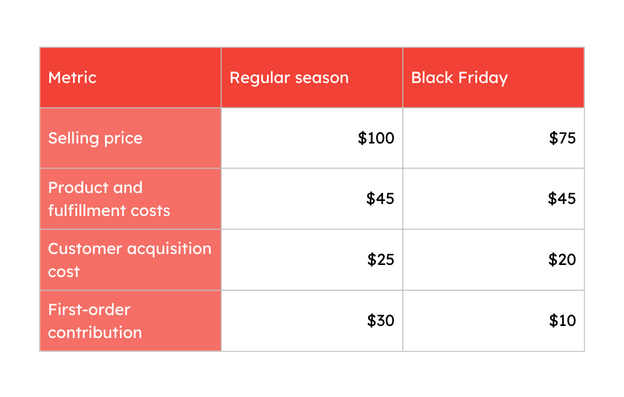
In this example, the Black Friday customer costs 20% less to acquire. However, the retailer generates approximately 67% less first-order contribution after acquisition expenses.
The lower CAC improves acquisition efficiency, while the discount reduces the contribution available to recover operating expenses and generate profit.
This explains why retailers should evaluate CAC alongside contribution margins, rather than relying exclusively on conversion rates or return on ad spend (ROAS).
Why Customer Lifetime Value Matters for Black Friday Acquisition
The profitability of Black Friday customer acquisition extends beyond the initial transaction.
Customer lifetime value (CLV) helps retailers estimate the financial contribution customers generate through subsequent purchases, accounting for retention patterns and the costs of serving them.
Deloitte's 2025 holiday research illustrates the challenge of building lasting relationships with promotional buyers. Its survey found that 89% of respondents planned to seek deals, while 77% intended to trade down to more affordable brands or retailers.
These findings highlight the importance of understanding how strongly customers associate a brand with its promotional pricing.
A first-time buyer attracted by a substantial discount may return at full price, purchase only during future promotional events, or switch to another retailer offering better value.
Each behavior produces different long-term acquisition economics.
For example, consider a retailer that earns $10 in first-order contribution from a Black Friday customer after acquisition costs. If that customer makes two additional purchases generating $25 in contribution each, the cumulative contribution reaches $60 before retention expenses. If the customer never returns, the contribution remains $10.
Retailers can evaluate these differences by comparing Black Friday customer cohorts against regular-season cohorts over 90, 180, and 365 days.
Tracking repeat purchase rates, time to second purchase, and cumulative contribution helps identify which acquisition channels generate customers with stronger long-term profitability.
The Impact of Returns on Black Friday Customer Value
Returns add another important consideration to acquisition profitability.
According to the NRF's 2025 Retail Returns Landscape report, retailers expected 19.3% of online sales to be returned, with total annual retail returns projected to reach $849.9 billion.
Although these figures cover the wider retail market rather than Black Friday specifically, they demonstrate the financial importance of evaluating retained revenue.
Returned orders can create reverse logistics costs, processing expenses, and inventory losses. When retailers acquire customers through paid media, these additional expenses reduce the contribution from the original transaction.
For categories such as apparel, where sizing and product expectations affect purchasing decisions, retailers should examine returns at the acquisition cohort level.
This allows businesses to distinguish between campaigns that generate high order volumes and those that deliver stronger retained margins.
Three Ways to Improve Black Friday Customer Acquisition ROI
Retailers can improve acquisition investment decisions by connecting campaign performance with customer-level financial outcomes.
1. Prioritize contribution-based acquisition metrics
Retailers should assess new customer acquisition cost alongside first-order contribution and expected customer lifetime value.
This approach helps identify how much the business can sustainably invest in different audiences and product categories.
2. Measure incremental new customer acquisition
Some customers attributed to paid media campaigns may have purchased without additional advertising exposure.
Incrementality experiments, including controlled holdout tests, help estimate the additional purchases generated by advertising investment.
By separating incremental conversions from attributed conversions, retailers can develop a more accurate understanding of acquisition effectiveness and allocate budgets accordingly.
3. Build retention strategies around first-purchase behavior
Retailers should segment Black Friday customers based on product categories, discount levels, and predicted repeat purchase potential.
For example, customers purchasing replenishable products may benefit from timely reorder reminders, while customers buying infrequently purchased products may respond better to complementary product recommendations.
These strategies can encourage subsequent purchases while keeping retention expenditure aligned with expected customer value.
Building a More Profitable Black Friday Acquisition Strategy for 2026
Deloitte's 2026 Holiday Retail Survey projects average household holiday spending of $1,654, up 4% from 2025. Gen Z and millennials are expected to account for half of holiday spending among surveyed consumers.
This presents retailers with opportunities to acquire new audiences while adapting promotional strategies to changing purchasing preferences.
However, the financial value of these customers will depend on the relationship between acquisition spending, promotional margins, and future purchasing activity.
Retailers can improve their investment decisions by analyzing historical customer cohorts, establishing contribution-based acquisition targets, and continuously measuring incremental customer growth.
For leadership teams, the central consideration is how effectively Black Friday investment contributes to profitable customer relationships over time.
The Bottom Line: Focus on Profitable Customer Acquisition
Black Friday offers retailers significant opportunities to expand their customer base. However, acquisition performance requires a broader financial assessment than immediate sales or conversion volume.
Retailers that incorporate contribution margins, incremental acquisition, returns, and customer lifetime value into their decision-making can identify which customers and campaigns justify continued investment.
The strongest Black Friday acquisition strategies will balance immediate revenue opportunities with the long-term profitability of the customers they attract.
Key Takeaways
· Black Friday drives customer acquisition opportunities: High consumer spending and purchase intent create opportunities for retailers to expand their customer base.
· Lower acquisition costs do not always mean higher profitability: Promotional discounts, fulfillment expenses, and returns can significantly reduce first-order contribution margins.
· Customer lifetime value determines long-term returns: Repeat purchases and retention rates help retailers assess whether Black Friday customers justify their acquisition costs.
· Incrementality improves investment decisions: Measuring incremental new customer acquisitions helps retailers understand the actual contribution of paid media to revenue growth
· Profitability should guide Black Friday budgets: Combining acquisition costs, contribution margins, and customer lifetime value enables more effective budget allocation and sustainable growth.
Relevant Insights
· Article: 5 Last-Minute Black Friday Campaign Ideas That Drive Conversions
· Article: Driving Holiday Conversions Without Discounts: 5 Strategies That Protect Margins and Build Loyalty
· Guide: The Executive Guide to Festive Storytelling: Turning Emotion into Measurable Growth
---
Unsure if your Black Friday acquisition strategy is driving profitable growth? Reach out to us.
About Crealytics
Crealytics is an award-winning full-funnel digital marketing agency fueling the profitable growth of over 100 well-known B2C and B2B businesses, including ASOS, The Hut Group, Staples and Urban Outfitters. A global company with an inclusive team of 100+ international employees, we operate from our hubs in Berlin, New York, Chicago, London, and Mumbai.
EXPERT INSIGHTS