Nine in Ten Agencies Use AI. Most Still Aim It at Routine Work.


The conversation about AI in marketing has been running well ahead of the reality for a while now. Spend enough time in rooms with senior agency and brand leaders and the gap becomes visible fairly quickly.
Nine in ten US marketing agencies now use generative AI, according to Forrester's State of AI Inside US Marketing Agencies, 2026. The adoption number is real. What the same report reveals, and what gets far less attention, is where that adoption is actually concentrated. Agencies are using AI for ideation, content drafts, competitive analysis, and performance reporting. 81% cite staff productivity as their primary objective for generative AI. Half also use agentic AI for marketing execution, and media and SEO strategy rank among the most cited use cases.
The open question is whether that use changes what agencies know and decide, or only how fast they deliver.
Why "We Use AI" and "AI Is Changing What We Do" Are Two Very Different Statements
Speeding up a brief is not the same as writing a better one. Generating ten headline variants in thirty seconds is useful, but if the strategic thinking behind the brief has not changed, the output has not fundamentally changed either. Most AI use in agencies right now sits in this category: existing work, done faster, at lower cost.
That has real commercial value. Reducing production cost, compressing timelines, removing the bottleneck between strategy and execution. None of that is trivial. But it is also not what the AI narrative in marketing is promising. The gap between what is being claimed and what is actually happening inside most organizations is where a lot of misaligned expectation lives.
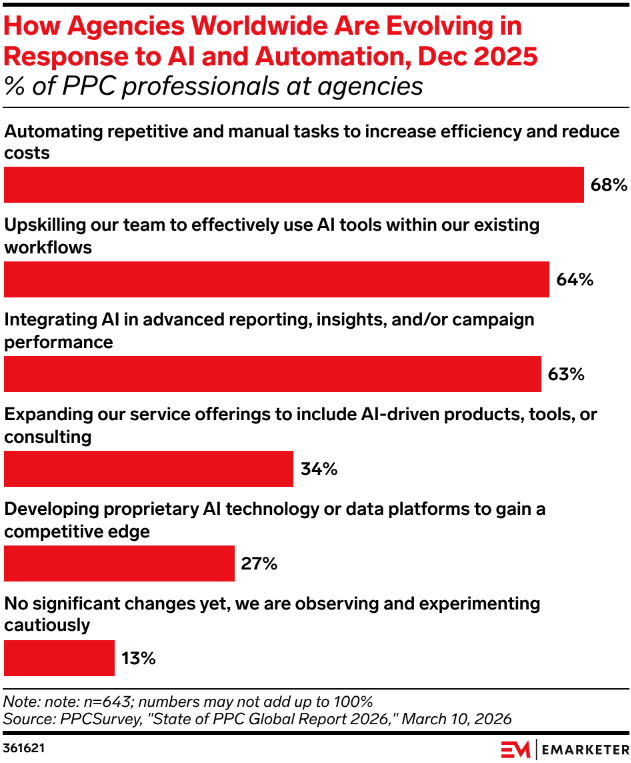
Source: PPCSurvey, State of PPC Global Report 2026 (n=643, fielded December 2025), via EMARKETER.
In a December 2025 survey of PPC professionals at agencies worldwide, 68% said their agency is automating repetitive tasks to increase efficiency and cut costs. 63% also said they are applying AI to advanced reporting and insights. Only 27% said they are developing proprietary AI technology or data platforms, and 34% said they are expanding into AI-driven services. Using AI is common. Building something competitors cannot copy is not.
The Routine Task Trap: Why Most AI Investment Is Not Producing Strategic Advantage
There is a pattern worth naming in how AI adoption tends to unfold inside large organizations. The first wave of use cases almost always targets tasks that are well-defined, repeatable, and already understood. Summarizing reports. Generating first drafts. Pulling competitive data. These are the use cases that get signed off quickly because the risk is low and the efficiency gain is measurable.
The problem is that most organizations stop there, or get stuck there longer than they intend to. The tasks that would generate genuine competitive advantage from AI are the ones that are harder to define, carry more organizational risk, and require a level of data infrastructure and internal capability that most teams are still building. Using AI to rethink media mix based on incremental contribution rather than attributed ROAS. Using it to model what a customer cohort acquired in Q4 will actually be worth by Q2. Using it to surface the creative signal buried in performance data that no human analyst would have the bandwidth to find.
Those applications exist. Forrester found that for AI agents, 54% of agencies cite lack of expertise and 51% cite data infrastructure gaps. Across all AI use, accuracy and bias (63%), legal concerns (62%), and privacy and security (55%) lead the list. What slows most organizations is a mix of skills, data foundations, and governance.
What Separates the Organizations Already Moving Beyond Routine AI Use
The organizations making genuine progress with AI tend to start from a different place than most. Before any tool gets selected, they ask what they want to be able to do that they currently cannot, rather than which existing tasks they can automate. That framing difference sounds small and changes almost everything downstream.
In the strategy and profitability work we do at Crealytics, the AI conversations that produce the most useful outcomes are the ones where the team has a specific commercial problem they cannot currently solve cleanly. Not a workflow to accelerate, but a question they genuinely cannot answer with the tools and processes they have. AI applied to a well-defined commercial question produces insight. AI applied to an already-efficient workflow produces a slightly more efficient workflow.
The Competitive Gap That Is Opening Between Routine and Strategic AI Use
The adoption headline can create a false sense of parity. If nine in ten agencies are using AI in their marketing operations, the assumption is that everyone is roughly in the same place. The reality is a distribution. In the planning conversations and senior rooms I am part of, the split is visible. Most organizations are using AI to do the same work faster and at lower cost. A much smaller group, fewer than the adoption numbers would suggest, are using it to do things that were genuinely not possible before.
That distribution can compound. The organizations building strategic AI capability now, the data infrastructure, the talent, the organizational muscle for AI-driven decision-making, are creating something that later movers will find difficult to close quickly. The efficiency gains from routine AI use are real but replicable. The insight and decision-making capability that comes from more ambitious AI application is harder to copy because it depends on proprietary data, organizational learning, and institutional knowledge that accumulates over time.
As Forrester’s Jay Pattisall puts it, the industry "is at risk of mistaking efficiency for effectiveness." An organization that has used AI to cut production costs and accelerate workflows has achieved something useful. An organization that has used it to change what it knows, how it allocates resources, and how it creates differentiation for clients has achieved something different in kind.
The Question Most AI Roadmaps Are Not Asking
Most AI roadmaps inside agencies are built around use cases: which tasks can be automated, which workflows can be accelerated, which roles can be partially augmented. That is a reasonable starting point and not where most organizations should stop.
The more generative question is: what does AI make possible that was not possible before, and is there a commercial problem in our business where that new capability would actually matter? That question is harder to answer than a use case audit. It requires a clearer view of where the real constraints on performance currently live, and enough organizational honesty to pursue the answer even when it points toward uncomfortable conclusions about existing practices.
Adoption has largely happened. The organizations that will pull ahead are the ones treating it as the beginning of a harder conversation about what AI should actually change.
What is your organization using AI to do that it genuinely could not do twelve months ago?
---
Need a clearer approach to using AI for value adding outcomes? Reach out to us.
Relevant Insights:
· Article: Stop Wasting Millions on Unused Marketing Content: How to Maximize ROI From Every Asset
· Article: How DTC Brands Can Use AI Without Losing the Human Touch
· Article: How Meme Content Drives Sales: A Guide for Modern DTC Brands
About Crealytics
Crealytics is an award-winning full-funnel digital marketing agency fueling the profitable growth of over 100 well-known B2C and B2B businesses, including ASOS, The Hut Group, Staples and Urban Outfitters. A global company with an inclusive team of 100+ international employees, we operate from our hubs in Berlin, New York, Chicago, London, and Mumbai.
EXPERT INSIGHTS