Incrementality During Peak Season: How Much Revenue Would Have Happened Without Paid Media?


Peak season brings increased consumer spending, higher advertising investment, and a surge in conversions. For businesses, this often translates into stronger revenue and higher reported return on ad spend (ROAS). However, seasonal demand, promotional discounts, and existing purchase intent also contribute to these results.
The scale of this demand is substantial. According to the National Retail Federation (NRF), US holiday retail sales are forecast to reach $1.013 trillion in November and December 2026, growing 4.2% year over year. Meanwhile, Adobe projects online holiday spending of $275.1 billion, a 6.7% increase.
These forecasts highlight the opportunity for retailers, but they also raise an important measurement consideration. Some purchases during peak season would occur regardless of advertising investment, driven by established shopping habits, brand familiarity, and seasonal promotions.
Incrementality measurement helps businesses estimate the additional revenue paid media generates beyond this existing demand. Understanding that contribution allows senior leaders to evaluate advertising effectiveness and allocate budgets based on measurable business impact.
Why Peak-Season ROAS Doesn't Reveal the Full Revenue Picture
Traditional ROAS measures how much revenue an attribution system credits to advertising relative to media expenditure. It provides an indication of campaign efficiency, but it does not establish how many purchases advertising caused.
The difference becomes especially relevant during periods of concentrated demand.
Adobe forecasts that Cyber Week will generate $47.5 billion in US online sales in 2026, representing 17.3% of total holiday e-commerce spending. Cyber Monday alone is expected to generate $15.1 billion.
During these shopping events, consumers actively search for products, compare prices, and respond to promotional offers. Paid search and retargeting campaigns can capture conversions from customers who already planned to purchase.
For example, an existing customer might search for a familiar retailer, click a branded search advertisement, and complete a purchase. The advertising platform may attribute the sale to paid search, although the customer might have purchased through an organic result without that advertisement.
As a result, reported ROAS can differ from the actual incremental contribution of media investment.
The distinction matters for budget allocation. A campaign with strong attributed returns may primarily capture existing demand, while another campaign with lower reported ROAS may introduce new customers and generate additional purchases.
How Much Revenue Would Have Happened Without Paid Media?
Incrementality measures the causal impact of advertising by comparing actual business outcomes with an estimated scenario in which the advertising activity did not occur.
This alternative scenario is called the counterfactual.
Consider a hypothetical retailer running a peak-season campaign:
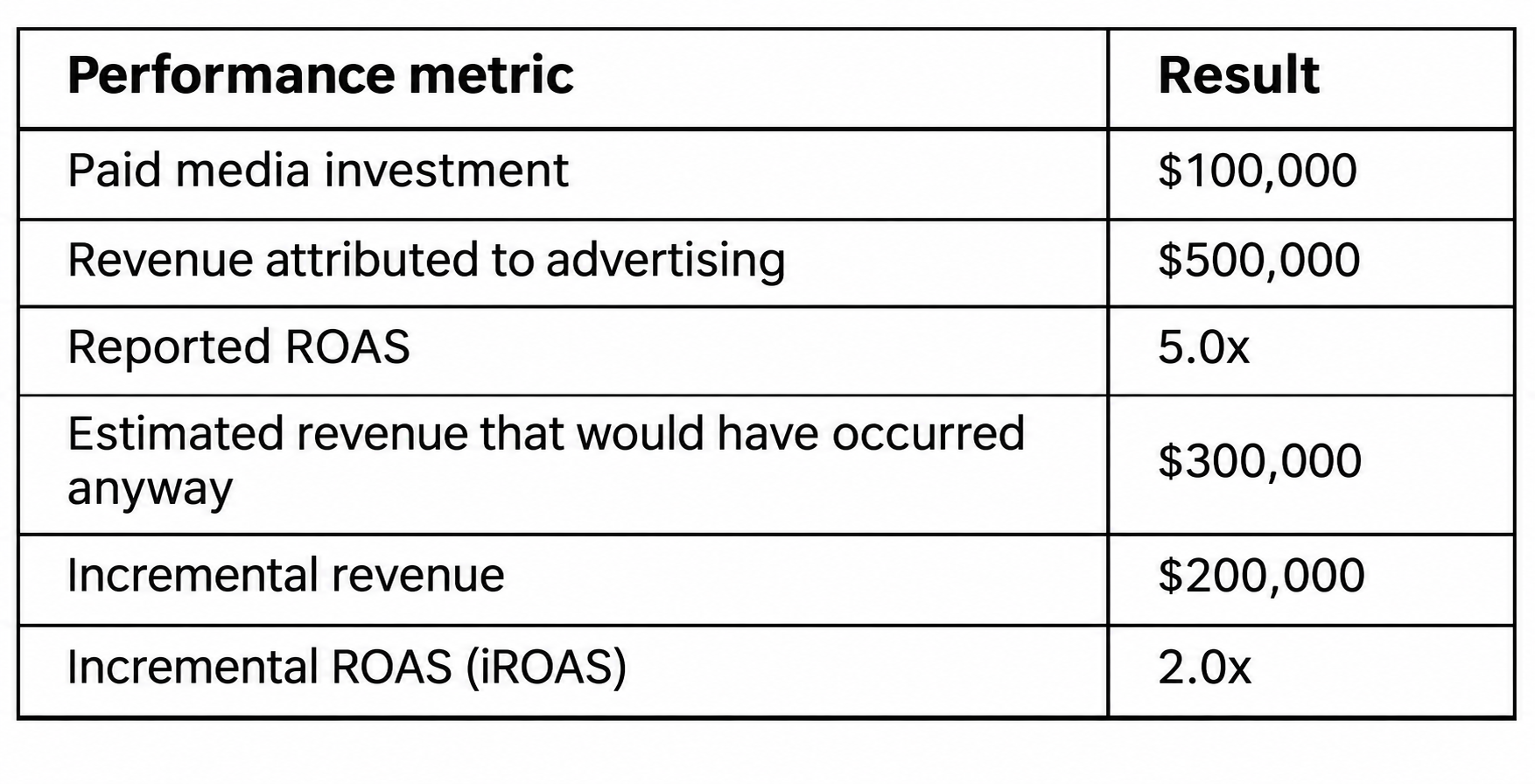
The retailer reports $500,000 in attributed revenue from a $100,000 advertising investment, producing a 5.0x ROAS.
However, suppose a controlled experiment estimates that $300,000 of the attributed revenue would have occurred without the campaign. The remaining $200,000 represents additional revenue generated by advertising.
The campaign's iROAS is therefore 2.0x.
This distinction has financial implications. If leadership evaluates the campaign solely through attributed ROAS, it may overestimate the revenue gained from additional advertising expenditure.
Incrementality provides a more direct assessment of the commercial impact of that investment.
The figures above are illustrative. Actual incremental revenue must be estimated through a suitable experiment or causal measurement model.
Three Factors That Complicate Incrementality During Peak Season
1. Seasonal Demand Can Increase Conversions Independently of Advertising
Peak-season sales reflect several overlapping influences, including promotional calendars, gifting occasions, product availability, and consumer purchasing plans.
Adobe expects US online spending to reach $95.8 billion in October 2026, growing 8% year over year. This suggests that significant purchasing activity begins ahead of the traditional November and December holiday window.
When businesses increase advertising investment during these periods, revenue may rise alongside media expenditure. However, observing both increases does not establish that advertising caused the entire revenue change.
A credible measurement approach must account for the underlying seasonal trend before estimating incremental impact.
2. Promotional Discounts Influence Purchase Decisions
Discounting provides another reason to separate attributed revenue from incremental outcomes.
Adobe forecasts discounts of up to 30% during Cyber Week 2026 across selected retail categories.
Consider a retailer that increases paid search spending while simultaneously introducing a 25% discount. Sales rise during the promotional period, and the advertising platform records higher conversion revenue.
Both the discount and advertising may contribute to this increase. Customers who were already planning to purchase could respond to the promotion even without additional media exposure.
By maintaining consistent promotional conditions across experimental groups, businesses can isolate the contribution of advertising more accurately.
Leadership should also consider profitability. Incremental revenue may translate into different levels of incremental contribution margin depending on discounts, product costs, fulfilment expenses, and media investment.
3. Multiple Channels Can Receive Credit for the Same Purchase
Peak-season purchasing journeys frequently involve several touchpoints.
Adobe's 2026 forecast anticipates that social media's share of attributed holiday revenue will grow 17% year over year, while the corresponding share for affiliates and partners will increase by 12%.
A consumer might discover a product through social advertising, compare alternatives, return through organic search, and complete a purchase after clicking a paid search advertisement.
Each channel contributes information about the purchasing journey, but individual attribution reports cannot independently establish the total additional revenue created by advertising.
This is particularly relevant for businesses running paid search, paid social, and retail media simultaneously.
Testing the incremental contribution of campaigns or channels helps leadership understand whether additional investment increases total business revenue or primarily changes where conversions receive attribution credit.
Relevant article:
How to Measure Paid Media Incrementality During Peak Season
Businesses can use several complementary measurement methods to estimate the incremental impact of advertising.
1. Geo-Lift Testing: Compare Performance Across Markets
Geo-lift experiments divide comparable geographic regions into treatment and control groups.
The treatment group receives the advertising activity being evaluated, while the control group receives reduced or no exposure to that activity.
Businesses then compare the differences in sales outcomes, accounting for historical demand and other market variations.
Google's geography-based Conversion Lift methodology supports this approach and provides incremental return measurements for eligible campaigns.
Geo-lift testing can be particularly useful for retailers with sufficient geographic coverage and reliable regional sales data.
Relevant Case Study: Unlocking Incremental Growth for Paid Social: How Retailer X Proved the Value of Meta Ads Prospecting
2. Conversion Lift Studies: Measure Additional Purchases
Conversion lift experiments use randomized treatment and control groups to estimate how advertising changes purchase behavior.
For example, a retailer could test a retargeting campaign by making some eligible customers available for advertising while withholding the campaign from a randomized control group.
Comparing conversion outcomes reveals whether the additional advertising exposure generates measurable lift.
These studies help businesses evaluate campaigns that target high-intent audiences, where attributed conversions may include purchases that would have occurred organically.
3. Marketing Mix Modeling: Evaluate the Broader Revenue Contribution
Marketing mix modeling (MMM) uses historical data to estimate relationships between business outcomes and factors such as advertising expenditure, pricing, promotions, seasonality, and economic conditions.
During peak season, MMM can help businesses evaluate how paid media contributes to revenue alongside other commercial influences.
However, model estimates depend on data quality and underlying assumptions. Calibrating MMM with experimental incrementality results can strengthen its usefulness for budget planning.
Together, experiments and modeling allow businesses to evaluate both specific campaign effects and broader investment performance.
"Testing ahead of peak gives brands the evidence to make smarter investment decisions before competition intensifies: identifying where to scale spend, which campaigns offer untapped growth and where budget can be reallocated to drive greater incremental returns." - Viktoriya Dyachenko, Strategic Insights Lead, Digital Marketing, Crealytics
For a deeper understanding of how to measure incrementality and assess the true impact of paid media, explore our Incrementality Guide.
Using Incrementality to Improve Peak-Season Budget Allocation
Incrementality measurement becomes most valuable when it informs investment decisions.
A business may discover that branded search generates strong attributed ROAS but relatively modest incremental revenue because many customers already intend to purchase.
Meanwhile, prospecting campaigns may deliver lower attributed ROAS while generating a larger proportion of additional sales.
These findings can help leadership evaluate where the next unit of advertising expenditure is likely to create the greatest commercial return.
Three metrics are particularly useful:
· Incremental revenue: Additional sales generated by advertising.
· Incremental ROAS: Additional revenue generated per unit of media investment.
· Incremental contribution margin: Additional revenue remaining after relevant variable costs, discounts, and advertising expenditure.
Businesses should also consider the marginal return from increasing or reducing budgets. Average campaign iROAS describes performance over the tested investment level, while marginal incrementality helps assess the value of the next investment.
During peak season, this distinction supports decisions about scaling campaigns, maintaining efficient coverage, or reallocating expenditure between channels.
Measuring the Revenue That Advertising Actually Adds
With US holiday retail sales forecast to exceed $1 trillion in 2026, businesses have considerable opportunities to capture consumer spending. They also face complex decisions about how much advertising investment contributes to the revenue generated during this period.
ROAS remains useful for monitoring attributed performance. Incrementality adds a causal perspective by estimating the revenue that would have occurred without advertising.
Combining attribution, controlled experiments, and broader measurement models gives senior leaders a stronger basis for evaluating paid media effectiveness.
The objective is to understand how much additional revenue advertising generates, what that revenue costs to acquire, and where future investment can create the greatest commercial value.
Relevant Insights
· Article: Peak Season Checklist: How to Drive Full-Funnel Growth During the Holidays
· Case Study: Holiday Season Success: How We Delivered 65% Higher Revenue with 24% Less Budget for a Leading Fashion Brand
· Article: 2026 U.S. Holiday Shopping Trends: What Brands Need to Know
---
Curious about how much of your revenue would have happened without paid media? Reach out to us.
About Crealytics
Crealytics is an award-winning full-funnel digital marketing agency fueling the profitable growth of over 100 well-known B2C and B2B businesses, including ASOS, The Hut Group, Staples and Urban Outfitters. A global company with an inclusive team of 100+ international employees, we operate from our hubs in Berlin, New York, Chicago, London, and Mumbai.
EXPERT INSIGHTS