How Industry-Wide Reliance on the Same Channels Is Compressing Returns

There is a question that surfaces in almost every senior marketing review I have been part of lately, usually framed as an execution problem when it is actually a structural one. The channel mix looks right. The automation is running. The platform dashboards report healthy efficiency. And yet the marginal return on the next dollar of spend keeps softening.
The explanation most teams reach for first is internal: the creative needs refreshing, the audiences need rebuilding, the targeting needs tightening. Those things may be true. They are rarely the whole answer. The more uncomfortable explanation is that the compression happens between accounts, in a market structure no individual dashboard can see.
Why Market Concentration Makes the Next Dollar More Expensive
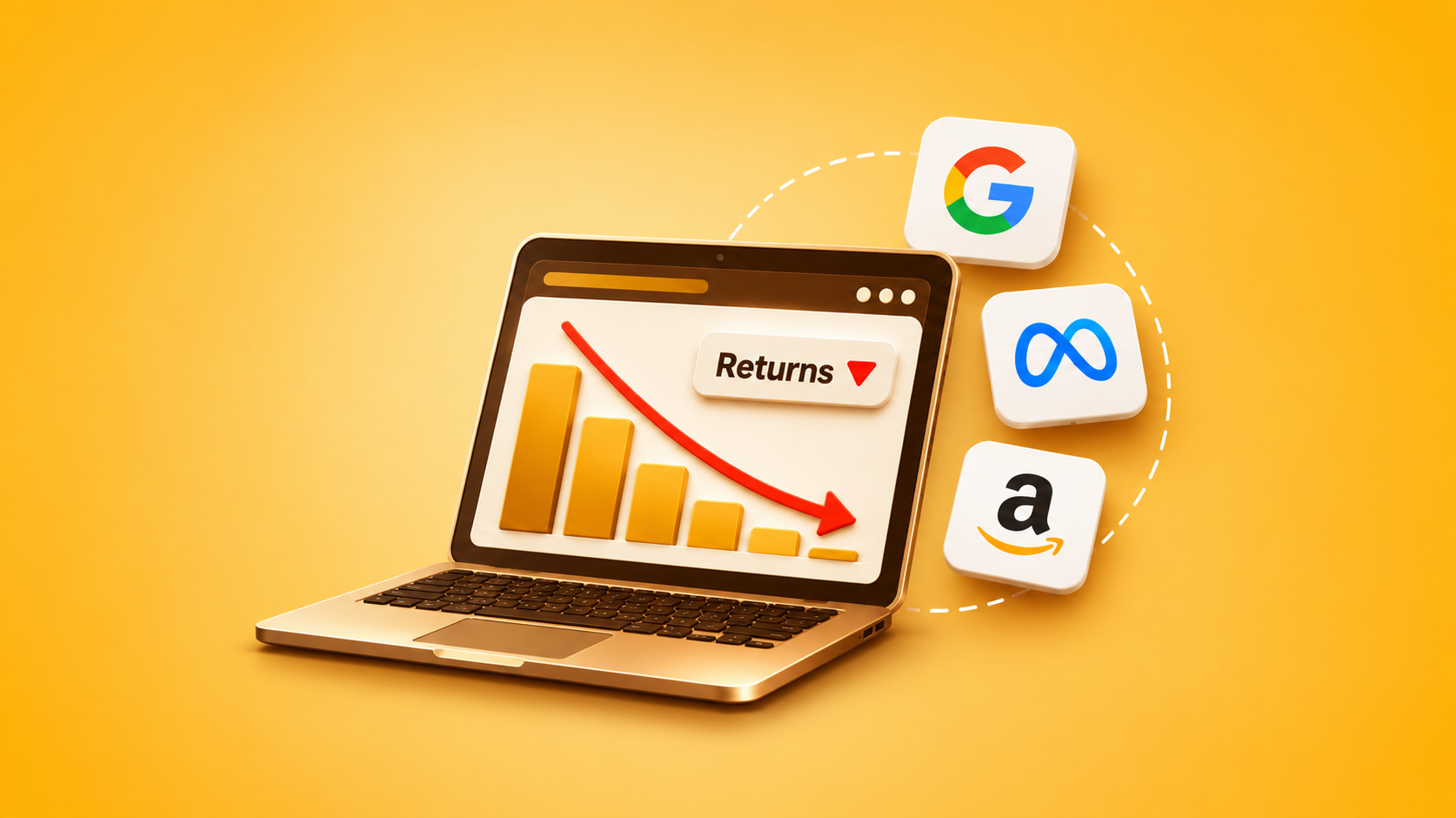
eMarketer projects that Google, Meta, and Amazon will together account for 62.3% of global digital ad spend in 2026, up from 59.9% in 2025. Three platforms absorbing the majority of global advertising investment, each running auction-based pricing, each competing for similar high-intent audiences across similar advertiser categories.
Meta’s Q3 2026 results show average price per ad up 14% year over year against impressions up 10%. Meta attributes the rise to improved ad performance and a stronger macro backdrop. Either way, advertisers are paying more per impression. When advertisers with comparable objectives, comparable audiences, and comparable return targets bid into the same auctions, the clearing price rises for all of them. A budget increase that wins a conversion from a competitor can raise the price that competitor pays on the next auction. The dynamic runs in both directions simultaneously. Both parties report activity. Both absorb a higher cost of acquisition. The platforms collect the difference.
I raise this with leadership teams because it changes what a flat or softening blended return means. None of it argues for pulling back from these channels. Pressure in that number may reflect the structure of the market rather than a flaw in execution. A team that reads a structural problem as an execution problem will invest effort in the wrong place.
How Automation Convergence Is Narrowing the Gap Between Strong and Average Accounts
Meta's Advantage+ and Google's AI Max now automate targeting, placement, bidding, and creative combinations inside a single objective. According to a Fluency survey of more than 170 advertisers, Performance Max adoption reached 71% in 2025, up from 60% in 2024. The baseline for accounts running these products has risen, and that is a genuine benefit to the market.
The consequence worth examining is what happens when competitors feed similar conversion signals into similar algorithms. The algorithms converge on similar audiences at similar bids. The edge that once separated strong accounts from average ones, sharper targeting, more deliberate audience construction, more considered bidding logic, now runs inside platform automation that every advertiser can access.
Competitive advantage in that environment shifts upstream, toward the inputs rather than the mechanics. First-party data quality, conversion values that reflect margin rather than revenue, product feed structure, and creative that gives the system something genuinely distinct to learn from. Trackier frames first-party data infrastructure as a competitive moat as automation standardizes the rest. Advertisers supplying only revenue as the optimization signal are asking the algorithm to chase the same buyers as everyone else, at the same price.
Where the Compression Is Already Showing Up in the Numbers
A survey commissioned by Taboola with Qualtrics (300+ US advertisers, April 2025) found that nearly 75% of performance marketers are experiencing diminishing returns from social media ad investments, with most saying diminishing returns affect more than 30% of their spend. The causes cited: audience saturation, rising costs, and ad fatigue. More than 80% are using multiple tactics to combat those returns, and more than half are expanding into additional channels beyond social.
That pattern is consistent with a concentrated, converged market. The same audiences are being reached by the same automation logic at rising cost across the same platforms. Expanding into additional channels is a rational response, but it addresses the symptom. The underlying dynamic persists as those channels attract more competition and the same convergence plays out over a longer timeline.
What Platform-Reported Return Cannot Tell You
The compression stays hidden when success is measured through platform-reported return. Attribution inside an ad platform credits conversions that would have happened without the ad, particularly from branded search, existing customers, and retargeting audiences that were already close to converting. In a crowded market, that over-attribution grows because more spend is chasing the same pool of high-intent buyers who were already on their way.
In the profitability audits we run at Crealytics, the distance between what platforms report and what incrementality testing reveals is often the most commercially significant finding. In one analysis from Crealytics' Incrementality Benchmark Report, Brand Search, the highest-converting channel in platform reporting, delivered incremental contribution as low as 5%, while Shopping campaigns in the same account showed incremental contribution between 60% and 110%. That gap matters: a 5% score means almost none of those conversions needed the ad to happen. A score above 100% means the channel drove more genuine demand than the platform had even reported — it was being under-credited, not over-credited. In a market where auction costs keep rising, paying for conversions that would have happened anyway is a direct commercial cost.
Gartner’s 2026 CMO Spend Survey found awareness and conversion now account for 62.6% of media spend, while loyalty and retention fell 29% since 2024 to under 15%. WARC’s doom loop research describes a related dynamic: brands that consistently deprioritize brand-building in favor of performance spend find that the performance channels become harder to sustain as underlying demand weakens. When most of the market concentrates on spending in the same places with the same measurement framework, the compressed return becomes a shared condition rather than a competitive signal.
Where the Actual Advantage Is Moving
Reducing exposure to compressed auctions does not mean abandoning them. The channels that absorb the majority of global advertising spend do so for structural reasons that are not going away. The question is what an organization does alongside them.
The brands I see sustaining stronger incremental returns tend to share a few practices. They supply the automation with better inputs than competitors: margin-based conversion values and first-party audience signals instead of revenue and algorithmic inference, creative that gives the model something distinctive to optimize toward. They measure against real incremental outcomes, so budget follows what is actually working. And they treat measurement as a strategic investment, building the internal capability to answer the question that the dashboard cannot: how much of this attributed return would survive if the spend stopped?
That last question is the one most resistant to a comfortable answer. It is also the one that, once asked honestly, tends to change how budgets are built.
The compression is real, it is structural, and it affects most advertisers in the same auctions. The organizations that navigate it best recognize it as a structural problem that more spend and better tactics cannot solve on their own.
Which line in your media plan would look different after an incrementality test?
---
Unsure whether your channels are actually driving incremental growth? Reach out to us
Relevant Insights
· Presentation: Triangulation: How to Master Your Marketing Measurement and Maximize ROI
· Report: A Guide to Marketing Measurement: How Leading Brands Combine MMM, Experiments, and Platform Data
About Crealytics
Crealytics is an award-winning full-funnel digital marketing agency fueling the profitable growth of over 100 well-known B2C and B2B businesses, including ASOS, The Hut Group, Staples and Urban Outfitters. A global company with an inclusive team of 100+ international employees, we operate from our hubs in Berlin, New York, Chicago, London, and Mumbai.
EXPERT INSIGHTS