Why the Multiplier Effect Still Matters in 2026: Brand, Performance, and AI-Driven Growth

Rethinking Marketing Effectiveness in an AI-Driven Media Landscape
For more than a decade, marketing leaders have been told to choose between brand and performance, long-term equity and short-term return. The Multiplier Effect challenged that logic early on, arguing that sustainable growth comes from integration rather than trade-offs.
In 2026, that tension has only intensified. AI-driven media buying, automated bidding, creative optimization, and emerging environments such as ChatGPT Ads promise speed and efficiency, while CFO scrutiny, weaker attribution, and rising consumer skepticism raise the bar for proof. In this context, the Multiplier Effect is no longer a legacy brand theory. It is a strategic framework for making AI-driven marketing work at a business level.
The Multiplier Effect Recap: How Brand and Performance Work Better Together
The Core Principle of the Multiplier Effect
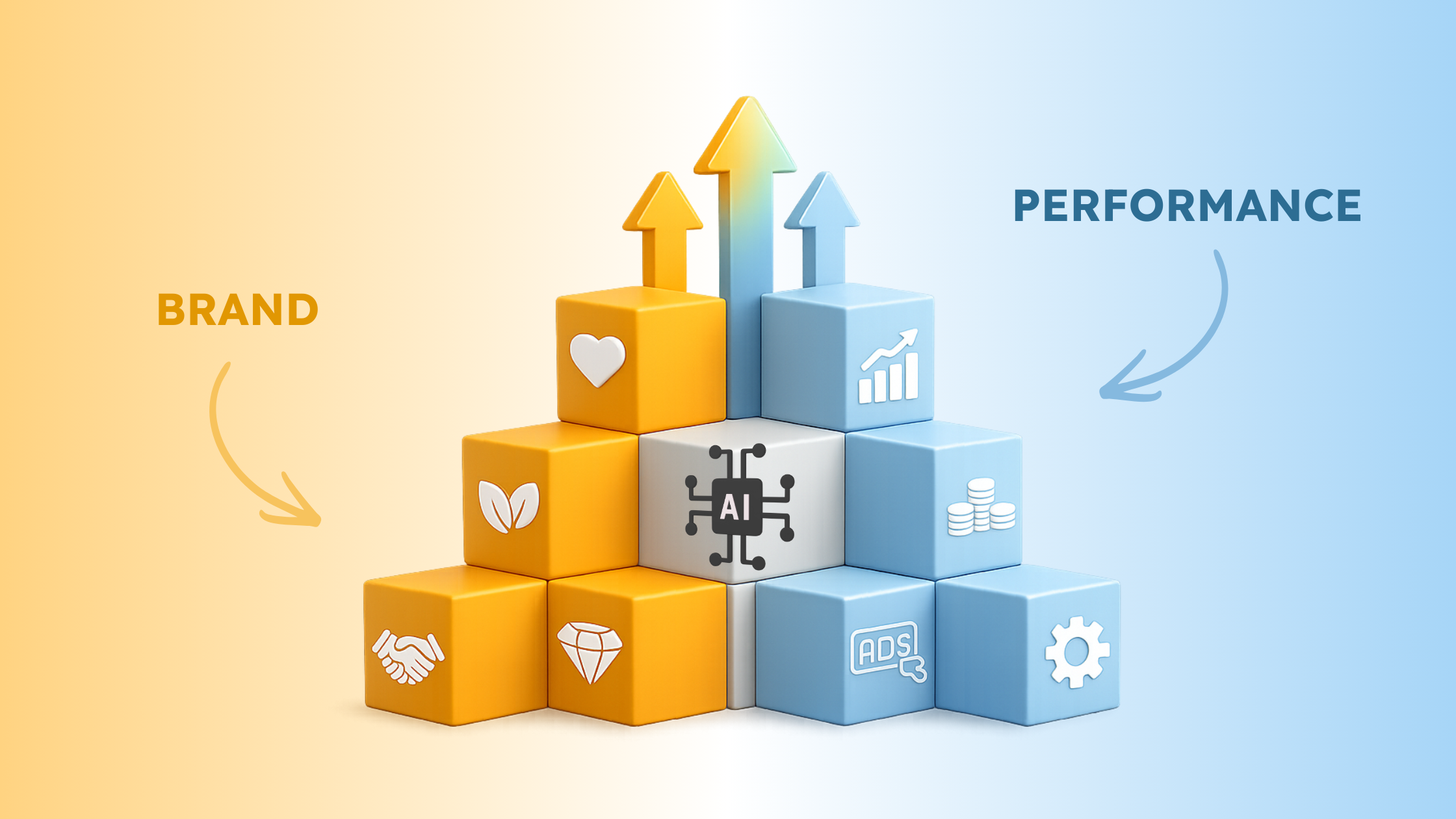
The Multiplier Effect was popularised by WARC research analysing thousands of campaigns across markets and categories. Its core premise is straightforward: brand and performance media do not compete for budget. When deployed together, they increase each other’s effectiveness.
WARC’s findings consistently show that campaigns combining sustained brand investment with performance activation deliver stronger overall returns than performance activity alone. Brand advertising builds mental availability, trust, and preference. Performance media then converts that demand more efficiently, improving response rates and lowering acquisition costs.
Multiplier Effect vs Funnel-Based Strategy: What’s the Difference?
At first glance, the Multiplier Effect is often confused with a traditional funnel-based strategy. Both acknowledge different stages of the customer journey. The difference lies in how those stages interact. Funnel models tend to be sequential and siloed, with awareness activity handing off to consideration and then to conversion. Performance is measured stage by stage.
The Multiplier Effect rejects this linearity. It assumes constant interaction between brand and performance signals. Brand activity improves performance efficiency immediately, not later. Performance learnings inform brand execution in real time. Rather than moving users down a funnel, the Multiplier Effect compounds impact across it, creating reinforcing loops rather than handovers.
How the Multiplier Effect Works in Practice
In application, the Multiplier Effect improves performance outcomes because brand activity primes audiences before conversion-focused messaging appears. Martech analysts and industry research have shown that this leads to higher-quality demand, stronger conversion rates, and more resilient growth.
Critically, the Multiplier Effect is not a fixed budget split. It is an operating model. It requires alignment across planning, creative, measurement, and incentives. Organisations that treat it as a media ratio miss the point. Those that embed it into how teams collaborate unlock compounding returns across the funnel.
Why the Multiplier Effect Matters More Than Ever in 2026 and beyond
AI Optimisation and the Limits of Performance-Only Growth
AI-driven bidding and targeting systems now optimise faster than human teams can intervene. Platforms prioritise signals that already exist, meaning they compete more aggressively for known intent. Without sufficient brand-driven demand entering the system, AI simply reallocates spend toward the same audiences, driving costs upward and compressing returns. Revisiting the Multiplier Effect reframes AI not as a growth engine on its own, but as an amplifier of underlying demand creation.
Relevant Article: The AI Bubble in Paid Media: Will It Continue to Float or Finally Burst in 2026?
ChatGPT Ads and the Rise of Conversational Discovery
Conversational interfaces are reshaping how intent forms. With environments such as ChatGPT Ads, recommendations and comparisons increasingly happen before users reach search engines or retail platforms. This elevates the role of brand credibility, clarity, and presence earlier in the journey. Performance media alone cannot influence these moments. The Multiplier Effect becomes essential for ensuring brand signals inform AI-mediated discovery and downstream activation.
Relevant Article: ChatGPT Ads: A Strategic Preparation Guide for Digital Media Leaders
The Decline of Attribution and the Case for the Multiplier Effect
Privacy regulation, signal loss, and walled gardens have weakened deterministic attribution. As Forbes and eMarketer have highlighted, over-reliance on last-click metrics encourages underinvestment in demand creation. Revisiting the Multiplier Effect provides a strategic response to this challenge by shifting focus from channel-level efficiency to total business impact, even when measurement certainty declines.
From Budget Efficiency to Business Effectiveness
Marketing budgets in 2026 are under renewed scrutiny. AI has already removed many operational inefficiencies. What remains is strategic efficiency: investing in activity that changes behaviour, not just reallocates credit. The Multiplier Effect helps leadership teams distinguish between growth driven by demand creation and performance that merely captures existing intent.
How to Apply the Multiplier Effect as AI Reshapes Marketing
Designing for Demand Creation in an Automated Media Environment
In an AI-driven media environment, automation optimises what already exists. Applying the Multiplier Effect in 2026 therefore starts with intentional demand creation. Brand activity should feed platforms with signals of preference, trust, and relevance before AI systems begin optimising bids, audiences, and formats. Without this foundation, automation simply competes for the same high-intent users, inflating costs. The Multiplier Effect reframes brand investment as a prerequisite for AI efficiency, not a trade-off against it.
Beyond ROAS: Measuring Business Impact in the Age of AI
As GenAI accelerates media execution, traditional attribution struggles to keep pace. Applying the Multiplier Effect today requires shifting measurement away from channel-level ROAS toward business outcomes such as incremental revenue, new customer growth, and margin contribution. This does not mean abandoning performance discipline. It means using incrementality and triangulated measurement to understand how brand activity improves downstream efficiency, even when AI-driven touchpoints obscure linear paths to conversion.
Aligning Brand and Performance Teams in an AI-Driven Organisation
AI disruption has reduced execution friction but increased strategic risk. When brand and performance teams operate separately, AI amplifies fragmentation. Applying the Multiplier Effect in 2026 requires organisational alignment. Planning, creative development, and budget decisions must be shared responsibilities. This ensures that performance activation reflects brand intent and that brand strategy incorporates real-time performance insight. Integration is no longer cultural preference; it is operational necessity.
Adapting to Non-Linear Customer Journeys in an AI-Mediated World
AI-powered discovery environments such as conversational assistants are compressing and reshaping the customer journey. Recent news around ChatGPT Ads signals a shift in how commercial intent is formed, influenced, and surfaced. Consumers may now move from awareness to consideration within a single AI-mediated interaction, without passing through traditional search or social touchpoints.
Applying the Multiplier Effect in this context means accepting non-linearity as the new default. Brand and performance activity need to operate simultaneously rather than sequentially. Brand signals need to be present wherever AI systems generate recommendations or comparisons, while performance channels remain primed to capture demand the moment intent crystallises.
Remember: conversions with AI is not a funnel disruption, but more a funnel compression.
Final Thoughts: Why Integrated Marketing Wins in the Age of AI
The Multiplier Effect has not lost relevance in 2026. It has gained urgency. AI amplifies whatever strategy sits beneath it. Brands that invest only in performance will automate inefficiency. Brands that integrate demand creation and demand capture will compound advantage.
For senior leaders, the question is no longer whether brand and performance work better together. The question is whether your organisation is structured, measured, and incentivised to let them do so. In an AI-driven media economy, integration is not a theory. It is a prerequisite for sustainable growth.
---
Unsure how to make brand and performance work harder together as AI reshapes marketing? Reach out to us.
Relevant Insights:
· Article: Organic vs. Paid Social Media: How to Balance Brand Trust and Performance Marketing
· Article: Will LLMs Replace Search Engines? How Brands Can Stay Visible in the AI Age
· Article: The Cost of Denying AI in Your Paid Media Strategy and Execution
About Crealytics
Crealytics is an award-winning full-funnel digital marketing agency fueling the profitable growth of over 100 well-known B2C and B2B businesses, including ASOS, The Hut Group, Staples and Urban Outfitters. A global company with an inclusive team of 100+ international employees, we operate from our hubs in Berlin, New York, Chicago, London, and Mumbai.
EXPERT INSIGHTS